

Muni University Council Launches Water Plant to End Chronic Water Shortages on Campus.
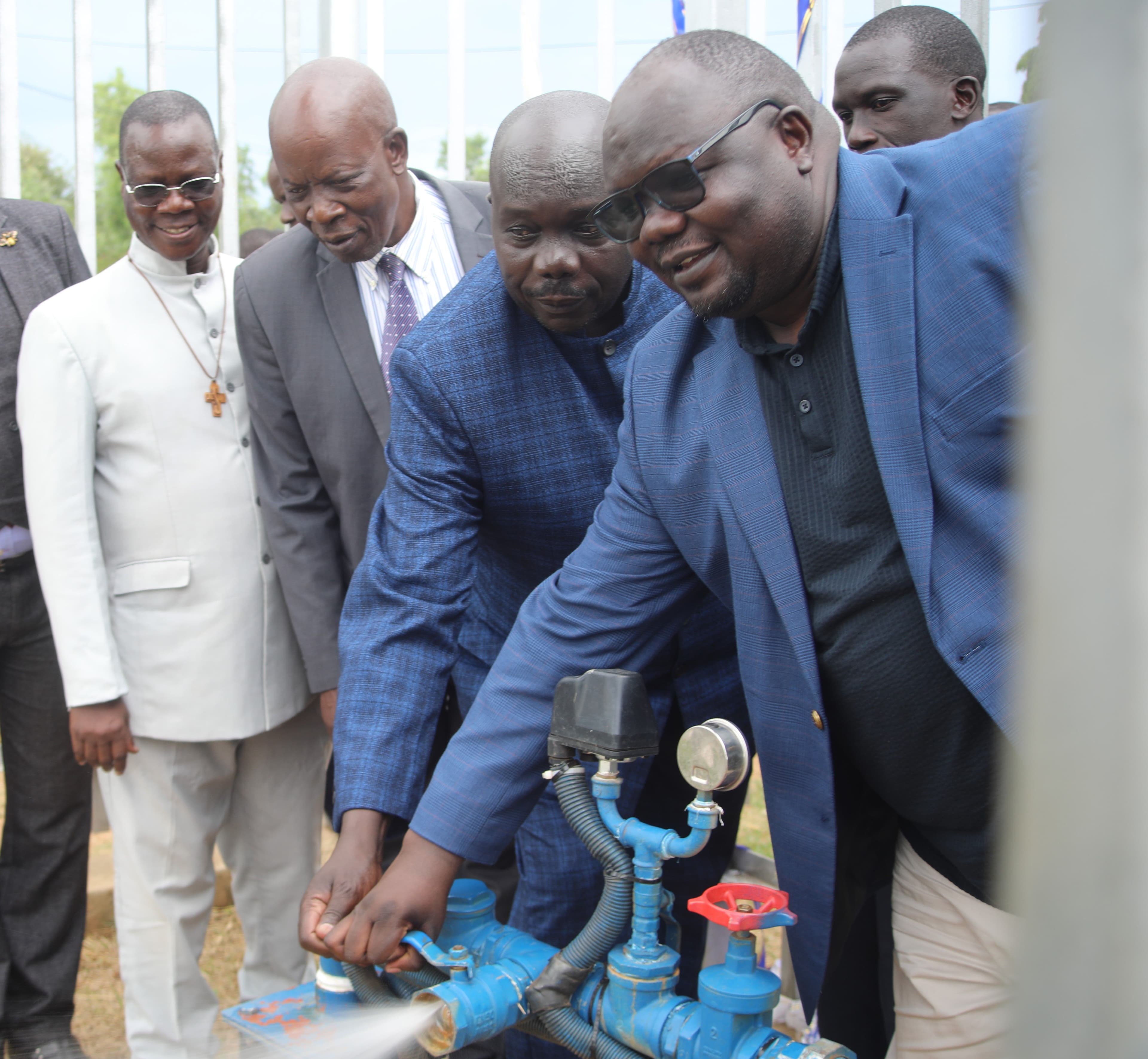
Deputy Vice Chancellor Finance and Administration Rev Fr. Picho, Dr. Jacinto Amandua, Chair Audit Committee of Council, Vice Chancellor Associate Professor Simon Anguma Katrini and Chairperson University Council Eng. Joel Aita during the launch of the water project.
Water scarcity continues to be a significant challenge in Uganda’s West Nile sub-region, affecting both communities and institutions. According to the Ministry of Water and Environment, safe water coverage in West Nile stands at about 47.5 percent, well below the national average of 69 percent. Many residents walk long distances to access water, often relying on unsafe rivers, streams, and shallow wells. UNICEF, the United Nations agency focused on children and health, reports that up to 85 percent of health facilities in West Nile lack reliable water sources, while WaterAid, an international NGO working on water, sanitation, and hygiene, estimates that over 18.5 million Ugandans do not have access to clean water near their homes. These challenges underscore the urgent need for sustainable water solutions, including within institutions like Muni University.
Against this backdrop, Muni University has implemented a sustainable and cost-effective solution: the Muni University Water Plant Project. The project, which encompassed drilling, installation, motorization, testing, and commissioning of a modern borehole system, was officially launched during the 37th Sitting of the University Council on March 24, 2026. Its primary objectives are to provide a reliable water supply, support academic, residential, and operational needs, and reduce the University’s dependence on inconsistent external water sources.
Engineer Joel Aita, Chairperson of the University Council, welcomed the project and emphasized its strategic importance for the University’s future. He noted that access to reliable water is critical not only for cost savings but also for the smooth running of academic and operational activities.
“This is a very good initiative. It will save the University from huge expenditure on water and enable us to direct resources to other priority areas that support teaching and learning.”
Associate Prof. Simon Anguma Katrini, Vice Chancellor, highlighted the academic and operational benefits of the project, especially during dry seasons when water scarcity has historically been a challenge for students and staff alike. He emphasized that ensuring reliable water access contributes directly to students’ ability to focus on their studies and laboratory work.
“This water project is a game changer, especially during the dry season. Our students will now have reliable access to water, allowing them to concentrate fully on their studies and laboratory activities without interruption.”
Engineer Willy Ochen, University Estate Manager, explained the practical benefits of the project, including financial savings and the opportunity for students to gain hands-on experience.
“This water project will save the University from spending exorbitant water bills. It will enable us to withstand water crises and ensure a reliable supply across the campus. We also involve students in such projects so they gain practical training, which is essential for their professional development.”
Rev. Fr. Prof. Odubuker Picho, Deputy Vice Chancellor for Finance and Administration, elaborated on the financial impact, noting that the University had previously spent significant amounts on unreliable water sources.
“We have been spending over UGX 200 million annually on water alone. This project being commissioned today will save resources previously spent on water bills, and these funds can now be used to support key University programs. I commend the University for supporting this initiative.”
Dr. Jacinto Amandua, University Council Member, highlighted the importance of reliable water for laboratory work and practical learning.
“This project has come at the right time. Many laboratory activities require a consistent water supply. With this system in place, students will be able to fully utilize laboratory equipment. I thank the Estate Department for thinking about and implementing this initiative.”
The commissioning of the water plant marks a milestone in Muni University’s commitment to sustainable infrastructure, cost reduction, and improving the learning environment. It also positions the University as a model for addressing one of West Nile’s persistent regional challenges while simultaneously enhancing operational efficiency and academic excellence.